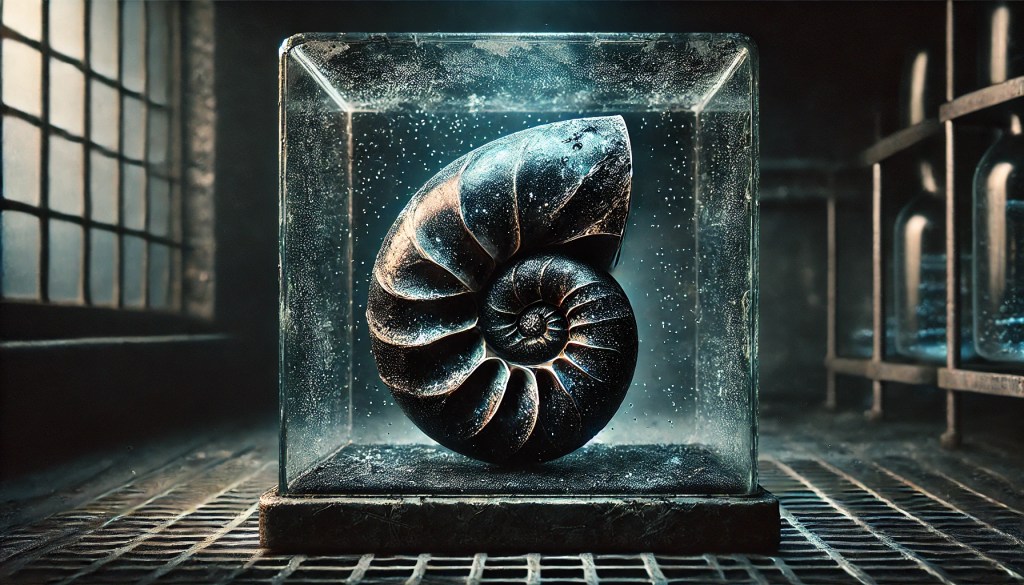
Author’s Note: Thank you for joining me on this journey. If you are new to this story, I suggest you start with Chapter 1. Your comments are very welcome!
The trip back to Earth was eerily silent.
Deia, Sam, and Jason were confined to a small compartment in the retrieval ship, separated from the artifact and the crew. The retrieval team had been professional and coldly efficient, giving them no indication of what would happen once they reached Earth. The sense of dread grew heavier with each passing hour.
Deia sat strapped into her seat, glancing over at Sam and Jason. Sam was pale, her hands resting on her lap, fingers twitching nervously. Jason’s jaw was clenched, his gaze distant, his body tense as if preparing for the inevitable. They had barely spoken since boarding the ship. There was nothing left to say.
The artifact was locked in containment, sealed off from them now. Whatever it had done to them—whatever power it held—was now in the hands of Nexus Corporation. And that meant they were no longer in control of their own lives.
When the ship finally entered Earth’s atmosphere and landed, the retrieval team moved swiftly. Deia, Sam, and Jason were escorted from the ship without ceremony, each flanked by armed guards. There were no explanations or reassurances—only the cold efficiency of a team following strict orders.
As they exited the landing bay, the trio was led down separate corridors without a word of warning.
“Wait—what are you doing?” Jason’s voice rang out, panic creeping in as the guards forced them apart. “We stick together!”
The guards didn’t answer, and Deia felt a surge of fear as she was pushed into a different hallway. She tried to catch a last glimpse of Sam and Jason, but they were quickly whisked away, disappearing from view.
“Where are you taking us?” Deia demanded, her voice tight with anxiety.
“Please cooperate, Ms. Ramos,” one of the guards said, his tone neutral but firm. “You’ll be briefed soon.”
Briefed. As if any of this made sense.
The cold halls of the facility felt sterile, oppressive. Deia’s mind raced as she was guided into a small, windowless room with nothing but a table and two chairs. The door shut behind her with a metallic clang, leaving her alone with her thoughts.
They were separating them. Isolating them. Why? What did they plan to do with them now?
Before Deia could dwell on the thought any longer, the door opened again. Two men entered, both wearing dark suits and carrying an air of authority that made Deia’s skin crawl. They moved with predatory calm, their expressions unreadable as they sat down across from her.
Neither spoke for a long moment, and Deia’s heart thudded painfully in her chest. The silence was suffocating.
Finally, one of the men leaned forward, steepling his fingers as he regarded her with cold, calculating eyes. “Ms. Ramos. Let’s talk.”
Deia met his gaze, forcing herself to remain calm despite the dread settling in her stomach. “Where are Sam and Jason? What’s happening to them?”
The man ignored the question, his voice smooth and unsettling. “You’ve encountered something… extraordinary. Something beyond our understanding. We need to be very careful about how we proceed.”
Deia’s throat tightened. She knew where this was going. “What do you plan to do with us?”
The second man, silent until now, finally spoke, his voice low and deliberate. “That depends on what you can tell us. We need to understand exactly what happened on Mars, and more importantly, what that artifact is capable of.”
Deia felt a cold sweat form on the back of her neck. These men weren’t scientists—they were something else—something worse. Their calm demeanor, the way they seemed to treat the situation as a puzzle to be solved rather than the life-altering event it had been for her and her team, made her stomach turn.
“We already gave you everything,” Deia said, trying to keep her voice steady. “The video footage, the data, the reports. You’ve seen what happened. It rewound us, reset our bodies to our mid-20s. That’s all we know.”
The first man leaned back, his eyes narrowing. “You may think that’s all you know. But the fact is, Ms. Ramos, you and your team have been altered by something we don’t fully understand. Your bodies are proof that this artifact has the power to manipulate biological systems—something that could be… useful.”
Deia’s pulse quickened. Useful. The word felt like a threat. “We didn’t ask for this,” she said, her voice tightening with frustration. “We were just doing our job, and now you’re treating us like experiments.”
“You are experiments, Ms. Ramos,” the second man said, his voice cold and factual. “The moment you came into contact with that artifact, you became something… different. We need to determine what that means.”
Deia’s mind raced. “So, what? You’re going to lock us up and study us? You’re not even telling me what’s happening with Sam and Jason. You can’t do this.”
The first man’s lips curled into a thin smile, but there was no warmth in it. “We can do whatever is necessary. You and your team are no longer private citizens, Ms. Ramos. You are assets. And as assets, you will be monitored and studied—until we understand the full extent of your condition.”
Deia’s blood ran cold. Assets. They weren’t people anymore. Not to these men. The weight of it crashed down on her—the realization that she, Sam, and Jason weren’t just prisoners of circumstance anymore. They were prisoners of the artifact.
“And the artifact?” Deia asked, her voice low, her fists clenched in her lap. “What do you plan to do with it?”
The second man tilted his head slightly, his eyes glinting with something dark. “That’s classified.”
A chill swept over Deia. The spiral wasn’t just a curiosity to them. They wanted to use it, control it. She had suspected as much, but hearing it confirmed made her stomach twist with nausea.
“We’ve already started containment protocols for the artifact,” the first man continued. “It’s being studied in a secure facility. You will not have contact with it again.”
Deia’s heart sank. “And what about us?”
The two men exchanged a glance, and the silence in the room became heavier.
“You will be kept in isolation for now,” the first man said finally. “Monitored. Evaluated. We need to ensure there are no… unintended side effects of your exposure. Until then, consider yourself under indefinite quarantine.”
Deia felt like the walls were closing in on her. “You can’t do this,” she whispered, her voice shaking. “We didn’t ask for any of this. We just want to go back to our lives.”
The second man stood up, smoothing the front of his suit. “Your lives, Ms. Ramos, are no longer your own.”
Deia’s blood ran cold as the men stood, preparing to leave. The door opened, and Deia’s mind raced for something—anything—to stop them, to change the course of what was happening.
But they were already gone, the door closing behind them with a final, metallic click.
Deia sat in suffocating silence, her heart pounding. She had no idea what was happening to Sam or Jason or whether they were being subjected to the same ominous meeting and veiled threats.
The realization settled in her chest like a heavy stone: they weren’t going home. Not now. Maybe not ever.
And the spiral? It wasn’t just a discovery anymore.
It was a curse.
Deia clenched her fists, her mind racing. She had to find a way out of this. For herself. For Sam and Jason.
But for now, all she could do was wait—and hope that she wasn’t already too late.
Dr. Elias Ward gripped the steering wheel of his aging sedan, knuckles white, as sheets of rain pummeled the windshield. The rhythmic thud of the wipers barely kept pace with the deluge, and the headlights struggled to pierce the murky darkness of the winding mountain road. He had disabled the car’s self-drive system—a reckless decision—but tonight, he craved control, even if it was just the illusion of it.
His thoughts churned like the storm outside. Another grant proposal rejected, another door slammed shut in his face. The panel of dignified scientists had listened with thinly veiled skepticism as he presented his research on sympathetic resonance—a theoretical framework that could, if realized, revolutionize medicine. Curing cancer, repairing genetic defects, even halting the aging process—all within reach if he could just get the funding.
But to them, it was junk science. Fringe theory. Not worth the paper his proposals were printed on.
He felt the weight of it all pressing down on him. His career was in a nosedive, his marriage teetering on the brink of collapse, and his personal life a labyrinth of unfulfilled promises and lingering regrets. The road ahead blurred as his eyes stung—not just from the strain of driving through the storm, but from the frustration boiling over inside him.
A flash of red and blue lights snapped him back to reality—the piercing wail of a siren cut through the roar of the rain. Elias glanced in the rearview mirror to see a state trooper’s vehicle tailing him, lights flashing insistently.
“Great,” he muttered, easing off the accelerator. He hadn’t noticed his speed creeping up, mirroring the urgency of his thoughts. He pulled over to the side of the road, the car’s tires skidding slightly on the slick pavement.
He rolled down the window as the trooper approached, rain pelting his face.
“License and registration, please,” the trooper said, his tone professional but firm.
Elias fumbled with his wallet, his hands shaking more than he expected. “Was I speeding, officer?”
“Fifteen over the limit, and in these conditions, that’s dangerous. Also, your vehicle’s self-drive system appears to be disabled.”
“I… I needed to drive manually,” Elias replied, not meeting the trooper’s eyes. “It’s been a rough day.”
The trooper studied him for a moment, then glanced back at his patrol car. “Wait here.”
Elias sighed, leaning back into his seat. The cold air and rain did little to soothe his frayed nerves. Minutes passed, and the trooper didn’t return. Instead, two more vehicles pulled up—blacked-out SUVs that screamed government.
His pulse quickened. “What the hell is this?”
A man in a dark suit stepped out of the lead SUV, accompanied by two others. They approached his car with purposeful strides, and Elias felt a knot tighten in his stomach.
“Dr. Elias Ward?” the man asked, his voice carrying the authority of someone used to being obeyed.
Elias hesitated. “Yes?”
“Please step out of the vehicle.”
He glanced around nervously. “What’s going on? Am I under arrest?”
“Not at all, Doctor. But we need you to come with us.”
“Who are you?”
The man flashed a badge too quickly for Elias to read. “We’re with a government agency that requires your expertise. There’s no time to explain here. Please, come with us.”
Elias looked at the trooper, who now stood silently by his patrol car, eyes forward as if nothing unusual was happening. The rain continued to pour, and the cold began to seep into his bones.
“Do I have a choice?” Elias asked, a mix of fear and curiosity battling within him.
The man gave a thin smile. “We’d prefer your cooperation.”
Against his better judgment, Elias nodded. “Let me grab my bag.”
One of the agents retrieved it for him, and before he knew it, he was ushered into the back seat of the SUV. The door locked with a soft click, and the vehicle pulled away smoothly, leaving his car abandoned by the roadside.
They drove silently, the windows tinted dark to prevent any view of the outside world. Elias tried to gauge how much time was passing, but without his phone or a watch, he was left in the dark—both literally and figuratively.
Eventually, the SUV came to a halt. The door opened, and he was guided onto a dimly lit tarmac where a sleek jet waited, engines humming softly. The rain had subsided to a drizzle, and the cold night air was sharp with the scent of jet fuel.
“Where are we going?” Elias asked as they boarded the aircraft.
“You’ll be fully briefed upon arrival,” the agent replied.
Exhausted and bewildered, Elias sank into a plush seat as the jet took off into the night sky. Sleep tugged at the edges of his consciousness, but his mind refused to rest. Questions swirled—Who were these people? What did they want with him? Was this some elaborate prank or a bureaucratic nightmare?
Hours later—or was it only one?—the jet began its descent. Peering out the window, he glimpsed dense forests stretching as far as the eye could see, illuminated by the pale glow of dawn. They landed smoothly on a private airstrip nestled amid towering evergreens.
Elias was escorted into a sprawling complex, its concrete and steel bones bearing the weight of decades, perhaps even dating back to the Second World War. Though modern additions had softened its brutalist edges, the structure itself whispered of an era when function mattered more than form. Inside, the corridors were a labyrinth of narrow passageways and reinforced doors, their original purposes long obscured by layers of renovation. He was led to a stark room—just a table, a few chairs, and an aging water dispenser humming in the corner. A large window overlooked a quiet forest, mist curling between the trees as if nature itself was reclaiming what time had forgotten.
“Wait here,” the agent said before leaving him alone.
And so he waited—minutes ticked by, then an hour. The silence was oppressive. He paced the room, occasionally sipping water to calm his nerves. He considered trying the door but suspected it would be locked—and even if it wasn’t, wandering around a secret facility unescorted didn’t seem wise.
Finally, the door opened.
A woman entered, dressed in a lab coat. Her dark hair was pulled back into a neat bun. She carried a tablet and offered a polite smile.
“Dr. Ward, thank you for your patience. My name is Dr. Elena Martinez. I’m the lead research coordinator here.”
“Where is ‘here,’ exactly?” Elias asked, unable to keep the edge out of his voice.
She gestured for him to sit. “I understand this is all very sudden, but we have a matter of utmost importance that requires your unique expertise.”
“My expertise? Last I checked, the scientific community isn’t exactly banging down my door.”
Dr. Martinez’s expression softened. “On the contrary, your work on sympathetic resonance has garnered significant interest.”
Elias felt a flicker of vindication mixed with suspicion. “From whom? No one takes it seriously.”
“We do,” she replied. “And recent developments have created a need for someone with your background.”
He leaned forward. “What kind of developments?”
She tapped on her tablet, bringing up a series of images that she turned to show him grainy photos of a spiral shaped, dark, and sleek object resting in what appeared to be a containment chamber.
“This artifact was recently recovered from a mission on Mars,” she explained. “It’s unlike anything we’ve ever seen. It exhibits properties that defy our current understanding of physics and biology.”
Elias studied the images, his analytical mind kicking into gear despite his confusion. “What does this have to do with me?”
“We’ve observed that the artifact emits a form of energy resonance—patterns that are remarkably similar to the theoretical models you’ve proposed in your research.”
His eyes widened. “That’s impossible.”
“And yet, here we are,” Dr. Martinez said calmly. “We believe that your insights could be instrumental in helping us understand and possibly harness the artifact’s capabilities.”
Elias leaned back, his mind racing. This was beyond anything he could have imagined. “Why all the secrecy? Why bring me here like this?”
“Time is of the essence, Dr. Ward. There are… security concerns. The nature of this artifact is highly classified, and we need to control the information flow.”
He looked at her, a mix of awe and apprehension. “You think my work can help you with this? You think I can make a difference?”
“Yes,” she said firmly. “But we need your full cooperation. Everything discussed here is under the highest level of confidentiality.”
Elias took a deep breath. This was his chance—the opportunity he’d been waiting for—validation of his life’s work, the potential to make a real impact.
But a nagging doubt lingered. “What aren’t you telling me?”
Dr. Martinez hesitated ever so slightly. “There are risks involved. The artifact has… affected those who’ve come into contact with it in unpredictable ways.”
“What kind of ways?”
“That’s part of what we need you to help us determine.”
He considered her words carefully. This was a leap into the unknown, fraught with potential dangers. But what did he have to lose? His career was in shambles, his personal life unraveling. This may be the fresh start he needed.
“Alright,” Elias said finally. “I’ll help.”
Dr. Martinez smiled. “Excellent. We’ll begin immediately.”
As she led him out of the room and deeper into the facility, Elias couldn’t shake the feeling that he was standing at the precipice of something monumental. The corridors they walked were lined with labs, observation rooms, and teams of scientists engrossed in their work.
They stopped in front of a large, secure door. Dr. Martinez placed her hand on a scanner, and the door slid open to reveal a chamber bathed in soft light. At the center stood the artifact—a spiraling construct that seemed to absorb and refract light in mesmerizing patterns.
Elias stepped forward, drawn to it. The closer he got, the more he felt a subtle vibration in the air, a resonance that resonated deep within him.
“Remarkable,” he whispered.
“Welcome to your new project, Dr. Ward,” Dr. Martinez said. “Let’s see what discoveries await.”
As he stood before the artifact, possibilities unfolding in his mind, Elias felt a spark of hope ignite—a chance to redeem his work and his life.
But lurking beneath that hope was an undercurrent of uncertainty. The artifact was an enigma, and its true nature remained a mystery.
Dr. Elias Ward stood before the spiraling artifact, mesmerized by its subtle energy. Its sleek, dark surface absorbed light in strange ways, casting shifting patterns on the walls of the chamber. The deeper he stared, the more he felt that peculiar resonance vibrating in the air, a soft hum that resonated with his body and mind.
But it wasn’t just the artifact that intrigued him—it was the implications of it. This thing, whatever it was, appeared to operate on principles far beyond human understanding. Yet, somehow, it aligned with his own research into sympathetic resonance—research that had always been, at best, theoretical.
As Elias stood there, trying to wrap his mind around it all, Dr. Elena Martinez reappeared by his side. She watched him carefully, her expression neutral but expectant. “Dr. Ward, we need to go over some of the effects this artifact has had on individuals exposed to it,” she said, pulling up data on her tablet. “What we’ve observed goes far beyond theoretical models.”
She tapped the screen, showing him a series of files—case studies of people who had come into contact with the spiral. Each entry contained descriptions of radical biological changes: rapid cellular regeneration, aging reversal, and in some cases, complete biological restructuring. The descriptions read like science fiction, but the stark clinical tone of the reports only made it more chilling.
“Take a look at this,” she said, swiping to one particular file. “Subjects exposed to the artifact experienced accelerated healing. Not just wound repair, but even the reversal of aging. One subject was in their 60s when they came into contact with the artifact, and now they’re biologically in their mid-20s.”
Elias’s eyes widened, the weight of what he was reading hitting him like a tidal wave. The sheer magnitude of what the artifact could do was staggering, but more than that, it was terrifying.
“This is impossible,” he whispered, shaking his head as he handed the tablet back. “I mean, theoretically, sure—if sympathetic resonance could be controlled at a quantum level, you might be able to manipulate matter, even living tissue. But this…” He trailed off, gesturing toward the artifact. “This is beyond anything we could achieve right now.”
Dr. Martinez raised an eyebrow. “But it aligns with your theories, doesn’t it?”
Elias sighed, feeling the familiar frustration rise within him. “My research is theoretical, Doctor. Sympathetic resonance is based on the idea that, in theory, you could manipulate matter by influencing the vibrational frequencies of individual particles at the quantum level. But that’s a far cry from being able to perform these kinds of biological feats.” He gestured again at the tablet, his hands shaking slightly. “I’ve spent years trying to prove just the physical effects are possible—simple manipulations, like bending a piece of metal or altering the structure of a material, all at the atomic level. I haven’t even scratched the surface of medical applications.”
“So, in theory,” Dr. Martinez pressed, her eyes narrowing slightly, “if you could manipulate matter at that level, you could cure diseases, correct genetic defects, maybe even reverse aging. Isn’t that where your research was headed?”
Elias hesitated, knowing where this conversation was going. “Eventually, yes. But that would be far in the future, long after we’ve mastered the technology. What you’re talking about—curing cancer, repairing genetic defects, healing people in real time—requires an entirely different level of precision. It’s not just about manipulating matter. You’d need to monitor individual cells, track every molecular process, and adjust them dynamically in response to changes. And to do that…”
He paused, shaking his head. “You’d need software and monitoring systems that operate at quantum speeds—processing capabilities that don’t exist yet, not even close. The hardware and algorithms to do that, to target individual cells or even DNA, would be orders of magnitude more complex than anything we can build right now. It’s not just a matter of figuring out the resonance. The medical applications would require massively complex quantum monitoring and feedback systems, capable of adjusting in real time to the smallest changes. You’d need processing speeds generations beyond anything that currently exists.”
Dr. Martinez folded her arms, clearly intrigued. “You’re saying that, even if we figured out the resonance manipulation, we’d still be missing the precision tools to use it effectively.”
Elias nodded, his frustration mounting. “Exactly. It’s like trying to perform brain surgery with a sledgehammer. Sure, you’ve got power, but no precision. I’ve always thought of my work as developing the scalpel—proving the fundamental concept that matter can be manipulated at that level. But the neurosurgery—the ability to actually use that scalpel to cure diseases or change DNA—that’s a different problem entirely. That’s years, maybe decades away.”
Dr. Martinez’s gaze flickered back to the artifact, and Elias could see the wheels turning in her mind. She wasn’t dismissing him, but she wasn’t swayed either. “Yet this artifact appears to be doing just that,” she said, her voice measured. “It’s exhibiting the kind of control over biological systems that you’ve only theorized. And it’s doing so in ways that are consistent with your research, even if the technology doesn’t exist to explain it.”
“That’s what terrifies me,” Elias muttered, his voice thick with apprehension. “If this artifact can do what you’re describing, then it’s operating on a level we don’t understand. It’s using principles we’ve barely begun to explore, and the fact that it’s affecting people this way without any kind of discernible control is… dangerous.”
Dr. Martinez nodded thoughtfully. “You’re right. The artifact doesn’t seem to have a predictable pattern. The changes it induces in people vary wildly. That’s why we need your help.”
Elias shot her a look, his brow furrowed. “My help? How?”
“We need someone who understands the theoretical framework behind what this artifact might be doing—someone who can help us figure out how it’s manipulating matter, why it’s affecting people the way it is, and—most importantly—how to control it.”
Elias let out a bitter laugh. “Control it? You want me to help you control something that’s rewriting the laws of biology? You’re asking me to turn this thing into a tool, like some kind of programmable device.”
Dr. Martinez met his gaze steadily. “Yes. That’s exactly what we’re asking.”
The enormity of the situation pressed down on him. Elias had spent years fighting for recognition, desperate to prove that his ideas weren’t just fringe science. Now, he was being asked to work on something that surpassed even his wildest theories. But this wasn’t about validation anymore—it was about something far more dangerous.
“You’re playing with fire,” Elias said quietly, his voice tight. “This artifact… it’s not just some piece of alien technology you can reverse-engineer. It’s doing things we don’t understand, things that are not under our control.”
Dr. Martinez’s expression softened, but there was a hard edge to her eyes. “That’s why we need you. Because if we don’t control it, someone else will. And that would be catastrophic.”
Elias felt a shiver run through him. He knew she was right. Whatever this artifact was, it was too powerful to leave in the hands of the unknown. But the thought of being responsible for unlocking its potential, for shaping the future of humanity using technology that could rewrite life itself—that terrified him more than he could admit.
He stared at the artifact, its spiral form seeming to pulse with unseen energy. He knew what was at stake. His entire career had been building to this moment, yet it felt like he was standing on the edge of an abyss.
“I’ll help,” Elias said finally, his voice quiet but firm. “But we have to be careful. This thing… it’s not just technology. It’s something else. And if we’re not careful, it will destroy us.”
Dr. Martinez gave him a nod, but there was something unreadable in her expression. “We’ll be as careful as we can. But we need answers, Dr. Ward. The world is watching.”
As she led him out of the chamber, Elias couldn’t shake the feeling that the spiral was watching him, too. And as much as he wanted to believe that he could control it, a part of him knew that it might already be too late.
Elias leaned over the console, his fingers flying across the touchscreen as he reviewed the latest data from the artifact. The readings were more complex than anything he had ever encountered, yet, as he stared at the numbers and graphs on the screen, a pattern began to form.
“Dr. Ward, what are you seeing?” Dr. Martinez asked, stepping up beside him. Her expression was focused, expectant. She had been overseeing his work with hawk-like attention since his arrival.
Elias straightened, running a hand through his hair. “It’s not random,” he said, his voice thick with surprise. “At first, I thought the artifact’s effects were chaotic, unpredictable. But they’re not.”
He tapped the screen, pulling up a series of overlapping charts. “When Sam first came into contact with the spiral, it regressed her age—completely by chance. That was the only random event. But after Deia connected with it, everything changed.”
“Changed how?” Martinez leaned in, her brow furrowed.
Elias brought up a detailed profile on the subject list—Deia, Sam, and several others the retrieval team had been quietly experimenting on. “After Deia’s final connection, the artifact no longer displays random effects. It’s consistent now. Every individual who touches it is reset to roughly 25 years old. It heals injuries, repairs genetic defects, but it’s always within the framework of that age.”
Martinez folded her arms, intrigued. “So Deia… programmed it?”
Elias shook his head. “Not exactly. But she somehow communicated with it—convinced it to stop the random alterations. It’s like the artifact made a decision. From that point on, it no longer behaves unpredictably.”
He turned, his eyes meeting Martinez’s. “There’s more. The specific changes it makes aren’t just broad age regression. They’re targeted. The artifact scans each individual’s biology and adjusts accordingly. It doesn’t just reset. It fixes.”
“Fixes?” Martinez repeated, her eyes narrowing.
Elias nodded. “Look at this case.” He pulled up the profile of a man in his 40s, one of the security personnel assigned to the facility. “He had a genetic heart defect—something that would have caused severe complications later in life. But after touching the spiral, not only was his age reset to 25, but the defect was corrected at a genetic level. No signs of the condition remain.”
Martinez studied the data on the screen, her expression unreadable. “And in Sam’s case?”
Elias pulled up Sam’s file. “Her age was regressed entirely by accident, before Deia’s interaction. It was the only truly random event we’ve recorded. But after Deia convinced the artifact to stop, Sam was brought back to her mid-twenties—just like the others.”
A slow realization dawned on him as he spoke. “The artifact is responding to each person’s unique biology. It’s almost… benevolent.”
Martinez didn’t respond immediately, her eyes still locked on the screen. Finally, she turned to Elias, her voice calm but sharp. “This is more than we could have hoped for.”
Elias frowned, sensing a shift in her tone. “We don’t know how far it goes, though. It’s healing people, sure, but we still don’t fully understand the limits. And there’s a moral question here. We can’t just keep using it without knowing—”
Before he could finish, Martinez’s radio crackled to life. “Dr. Martinez, you’re needed in Lab 3. We have another subject ready for contact with the artifact.”
She glanced at Elias, then tapped her radio. “On my way.”
Elias’s stomach twisted. “You’re still running experiments?”
“We have to understand the artifact’s full potential, Dr. Ward,” Martinez said, turning to leave. “You’ve made incredible progress, but we need more data. We need to know exactly what we’re dealing with.”
Elias grabbed her arm, his voice tense. “You’re using people as test subjects.”
Martinez pulled her arm free, her eyes cold. “Every individual has volunteered, knowing the potential risks. This could change everything—medicine, human longevity. If you don’t want to be a part of that, fine. But don’t stand in the way of progress.”
Elias opened his mouth to argue, but a sudden beep from the console caught his attention. A new set of readings had appeared, connected to the latest subject about to touch the artifact.
He stared at the screen, his heart sinking. “Wait. This subject… has a pre-existing neurological condition. Are you sure it’s safe to—”
Martinez was already heading out the door, her voice clipped. “We’ll find out soon enough.”
Elias stared after her, frustration and dread battling for control. He knew that once the artifact had shown its ability to heal, there would be no stopping the experimentation. But the artifact wasn’t just a machine to be used at will. It was aware in some way, and he wasn’t sure how much more pressure it could take before things went wrong.
Against his better judgment, he followed Martinez down the hall to Lab 3. The closer they got, the louder the thrum of the artifact’s energy seemed to grow. The door slid open, revealing the chamber where the latest volunteer, a young woman in her early 30s, stood in front of the containment unit housing the spiral.
Elias could see the fear in her eyes, but also the hope. The same hope that had driven so many others to step forward and touch the artifact, believing it would save them.
Martinez stood by the observation window, her expression unreadable as the woman hesitated, then reached out. Her fingers brushed the smooth surface of the spiral.
The room filled with that familiar hum—a low vibration that seemed to resonate through the walls and into Elias’s bones. The spiral began to glow faintly, just as it had in previous experiments. The woman’s body stiffened, her eyes widening in shock as the artifact’s energy washed over her.
Elias’s breath caught in his throat. He had seen this before. The spiral was resetting her, just as it had done to Sam, Deia, and countless others.
But something was different this time. The woman’s body began to tremble, and a sudden sharp spike in the readings flashed on the monitor. Elias’s eyes darted to the screen. Something was going wrong.
“Stop it!” Elias shouted, rushing forward. “She has a neurological disorder! The artifact might not—”
Before he could finish, the woman collapsed to the floor, convulsing violently.
“Shut it down!” Elias yelled, but Martinez was already issuing orders to the team. The spiral dimmed, its energy fading as the containment unit closed around it once more.
Medics rushed into the chamber, lifting the woman onto a stretcher as she gasped for air, her body still wracked with tremors. Elias pressed his hands against the glass, watching helplessly as they carried her out.
“What the hell happened?” Martinez demanded, turning to Elias.
Elias felt his chest tighten. “The artifact tried to fix her—just like it’s done with everyone else. But her condition was too complex. It didn’t know how.”
Martinez’s face hardened. “And now?”
Elias shook his head. “I don’t know. But this proves what I’ve been saying—we’re pushing it too far. The artifact is intelligent, but it’s not perfect. It’s responding to each person’s biology, but that means it can also make mistakes.”
Martinez stared at him for a long moment, her expression unreadable. Then she turned away. “Keep working, Dr. Ward. We need to understand exactly where that line is.”
Elias stood there, watching as she left, his mind racing. He had always known the artifact was powerful, but now he understood something else—it wasn’t infallible. And if they kept pushing it, they might reach a point where the consequences were irreversible.
As he turned back to the spiral, still pulsing faintly behind the containment glass, Elias couldn’t shake the feeling that they were playing with something far more dangerous than they could ever control.
And he had no idea how long they had before it pushed back.
Elias leaned over the 3D printer, eyes focused intently on the small, intricate model of the spiral forming in the silica. The machine hummed steadily, layer by layer building the miniature replica of the artifact. He had been working for hours, meticulously designing these test models to see if the shape itself—without the artifact’s energy—could be used as a template for monitoring the real thing.
“Dr. Ward,” a voice called from the doorway. Dr. Martinez stood with her arms crossed, watching him closely. She had been checking in on him more often since the last incident, her expression harder, colder. “How’s it going?”
Elias wiped the sweat from his brow, not bothering to look up. “It’s almost done. I’m hoping these models will help us measure the energy resonance more precisely. Maybe if we can build tools shaped like the spiral, we can monitor the artifact without risking further human contact.”
Martinez raised an eyebrow. “And you think a 3D-printed model will tell us that?”
Elias shrugged. “We have to start somewhere. Right now, we’re flying blind. If we can map the resonance patterns at a smaller scale, we might understand how the artifact is manipulating matter. These test models are inert, just silica—no risk of triggering any effects.”
The printer beeped, signaling the completion of the model. Elias let out a breath of relief and reached inside the chamber to retrieve it. The miniature spiral fit perfectly in the palm of his hand, smooth and cool to the touch. He turned it over, admiring the detail.
“Let’s see if we can run a basic test,” he said, stepping over to the monitoring station. “I’ll start by scanning the—”
The words died in his throat as the room around him seemed to shift.
Suddenly, Elias felt a strange pulse shoot through his body—an unmistakable resonance, like the one he had felt when near the real artifact. His heart pounded, his chest tightened, as an overwhelming sensation of connection surged through him.
“What—what’s happening?” he gasped, stumbling backward, clutching the small spiral in his hand.
“Ward!” Martinez’s voice snapped through the haze. “Elias!?”, she yelled, worry and alarm coloring her voice. Elias barely heard her. He was no longer in the lab. His mind was somewhere else—somewhere deeper, darker.
His vision blurred, the edges of the room fading, as he felt the energy of the real spiral hum in sync with the small model in his hand. The resonance grew stronger, vibrating through his bones and cells. It wasn’t just a physical sensation—it was a connection, like the real spiral was reaching out to him, pulling him in.
Martinez grabbed his arm, shaking him. “Elias, let go! What the hell are you doing?”
“I—I can’t,” he stammered, his voice thick with panic. His grip tightened involuntarily around the small spiral, the hum intensifying. His body trembled, the world spinning.
And then it hit him—the same wave of energy he’d seen in Sam and Deia—the reset.
The sensation was overwhelming. His skin prickled, and a deep warmth spread from the core of his body outward. His heart raced, then slowed, and his breath came in shallow gasps as he felt time itself twist inside him.
His muscles tightened, his skin smoothed. His body seemed to shed years in a matter of seconds. It wasn’t painful, but it was all-consuming. He felt younger—stronger—his mind clearer, sharper.
The miniature spiral fell from his hand, clattering onto the floor.
Elias gasped, leaning against the edge of the workbench for support. The room slowly came back into focus. He blinked, his heart still pounding in his chest. He looked down at his hands—his fingers slimmer, his skin smoother.
Martinez’s eyes widened. “Elias… look at yourself.”
He looked up into the reflective surface of the lab’s monitoring screen and froze. The face staring back at him wasn’t the man in his late thirties he had seen that morning. No—this face was younger—mid-twenties, just like Deia and Sam.
“I… I’ve reset,” he whispered, his voice trembling. His mind struggled to process what had just happened. “The spiral—it connected with me through the model.”
Martinez’s face twisted in shock and anger. “You told me these models were inert! What the hell just happened?”
Elias shook his head, still dazed. “I—I didn’t think it was possible. It was just a small-scale replica. I wasn’t trying to connect to the real artifact. But somehow, when I touched it—”
Martinez cut him off, her voice sharp. “Do you realize what you’ve just done? You’ve been altered by that thing. You didn’t even touch the real artifact, Elias. This changes everything.”
Elias stumbled to a chair, his mind reeling. The reset—it had happened to him, just like it had happened to Deia and Sam. But he had only touched a model, a silica replica of the spiral.
“How is this possible?” he muttered, staring at his own hands in disbelief. “How can the connection be so strong through a replica?”
Martinez turned away, her hands pressed against her temples as she paced. “This is a problem, Elias. A big problem. The artifact’s influence is even more far-reaching than we thought. If even a small model can connect like this…”
Elias stood, trying to regain his composure. His mind was racing, the implications of what had just happened crashing down on him. He had accidentally tapped into the power of the artifact through a simple replica. What did that mean for the real spiral? For the rest of the world?
“We need to study this,” he said, his voice steadier now. “I need to figure out how the connection works. Maybe the spiral’s shape itself is a conduit—maybe the resonance is embedded in the very design of the spiral. If I can replicate the effects on a smaller scale, we can control it.”
Martinez turned, her expression unreadable. “Elias, you’ve just put yourself in the same category as Deia and Sam. The military’s not going to be happy about this.”
He felt a shiver run down his spine. “I didn’t mean for this to happen.”
“I know,” Martinez said, her tone softening slightly. “But now we have a real issue. If this technology is that sensitive—if it can affect people through something as small as a replica—then we’re in way deeper than we thought.”
Elias clenched his fists, trying to ground himself in the moment. “This could be a breakthrough. We might be able to harness the power of the spiral, use it for good. But we have to be careful. If the wrong people—”
“We are the wrong people, Elias,” Martinez said quietly. “And now, you’ve just given them more reason to escalate things.”
Elias stared at the small spiral model lying on the floor, its delicate shape shimmering under the lab lights. The pulse of the real artifact still echoed faintly in his mind, a reminder of the power he had just tapped into.
The reset had changed him, just like it had changed the others. And now, there was no turning back.
“What do we do now?” he asked quietly.
Martinez’s eyes hardened. “We don’t have a choice. We move forward. And you, Elias—you need to figure out how this happened before someone else does.”
Elias nodded, though a cold knot of fear tightened in his gut. He had touched something far beyond his control, and now the spiral wasn’t just a theoretical puzzle—it was a living force. And it had chosen him, too.
As Martinez left the lab, Elias leaned over the workbench, staring down at the small spiral model. His reflection stared back at him—young, unfamiliar, and full of uncertainty.
He wasn’t just studying the artifact anymore.He was connected to it.
Author’s note: Thank you for continuing to read my story. Your thoughts and suggestions at this point are very welcome, so leave me a comment, positive or negative! The next chapter, “The Leak“, is coming soon.
 J. Carlo Vegas
Leave a comment